An Oasis in the Desert: Historic Little America
The story of Little America, located on the windswept plains of western Wyoming near Granger, is one of the most enduring legends of American roadside hospitality. It is a tale that begins with a life-threatening blizzard in the 1890s and evolves into a multi-billion-dollar empire, proving that in the vastness of the Wyoming desert, a well-placed oasis is worth more than gold.
A Night of Desperation in 1894
To understand Little America, one must first understand the isolation of the Wyoming landscape in the late 19th century. In 1894, a young sheepherder named S.M. Covey found himself caught in a devastating "whiteout" blizzard. He was miles from any shelter, lost in the sagebrush of what was then Uinta County (now Sweetwater County).
As the legend goes, Covey spent a harrowing night huddled against the bitter wind, certain he would not survive until morning. In his state of near-hypothermia, he hallucinated or dreamed of a warm, bright shelter: a place where a traveler could find a hot meal, a soft bed, and protection from the elements. He survived the night, but the memory of that "imaginary oasis" never left him.
Decades later, as the Lincoln Highway (the nation’s first transcontinental automobile route) began to bring "tin can tourists" through Wyoming, Covey saw an opportunity to turn his survival dream into a reality.
The Founding of the "Oasis" (1934)
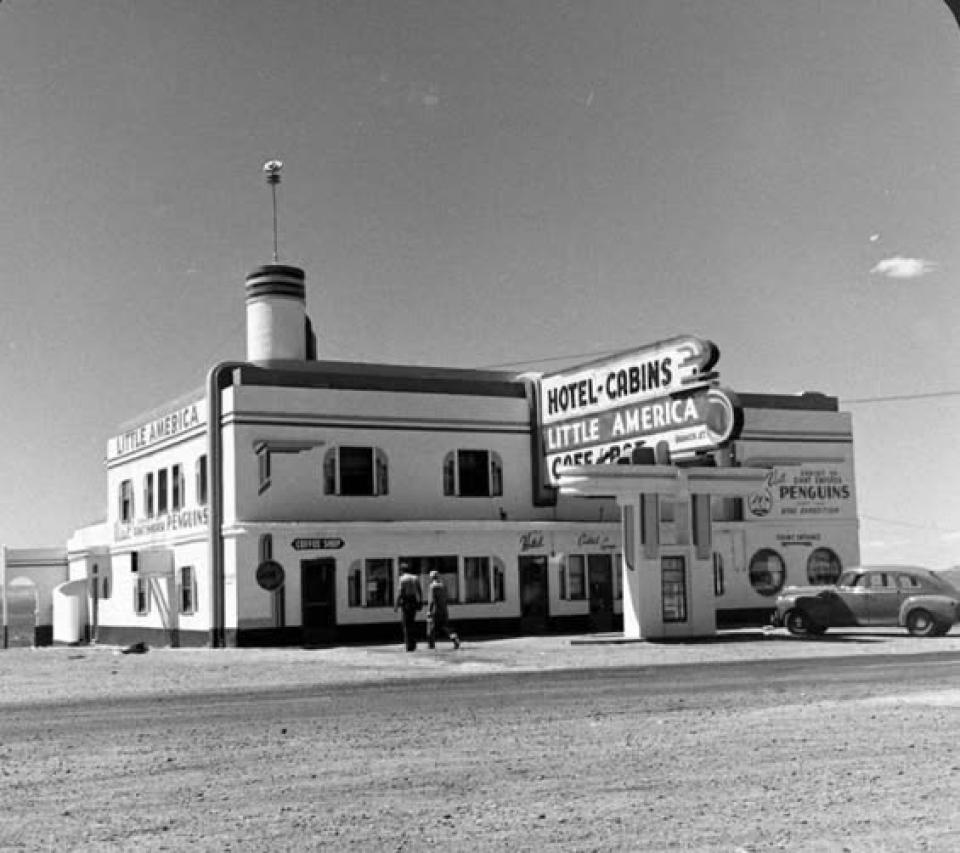
In 1934, at the height of the Great Depression, Covey began construction on a site he called Little America. The name was inspired by Admiral Richard E. Byrd’s base camp in Antarctica, which was headlining news at the time. Covey felt the comparison was apt: his station was a remote outpost in a frozen, desolate territory, much like Byrd’s Antarctic headquarters.
The original facility was modest but revolutionary for its time. It featured two gas pumps, a 24-seat café, and twelve guest rooms. It was strategically located at the junction of U.S. 30 (the Lincoln Highway) and U.S. 189. In an era when cars were unreliable and heaters were primitive, Little America was a literal lifesaver.
The Holding Era: From Managers to Owners (1952)
While Covey founded the site, the modern empire of Little America is the result of the vision of Robert Earl Holding and his wife, Carol.
In 1952, Earl Holding was a young man working at a civil engineering firm in Salt Lake City. He and Carol were offered the opportunity to manage the struggling Little America station in Wyoming. At the time, the facility was isolated and difficult to staff. The Holdings moved into a small apartment on-site and began working eighteen-hour days. Earl pumped gas and fixed tires, while Carol cooked meals and cleaned rooms.
The Holdings recognized that in Wyoming, the weather was their best salesperson. During the frequent Interstate 80 closures (the road that eventually replaced the Lincoln Highway), hundreds of travelers would be stranded at their doorstep. Instead of gouging customers, the Holdings focused on quality and volume.
The Marketing Genius of the Penguin
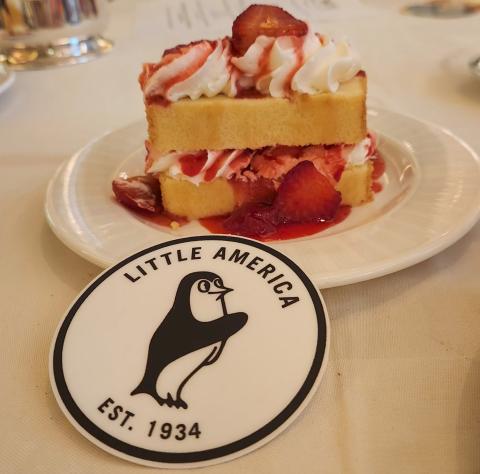
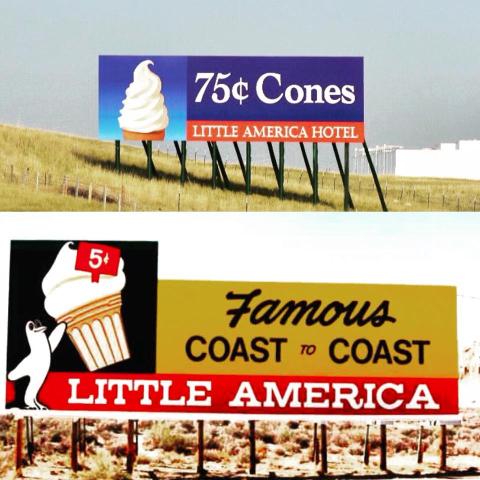
Earl Holding was a master of iconography. He leaned heavily into the Antarctic theme, adopting the Emperor Penguin as the mascot. To travelers driving through 100-degree summer heat or -20-degree winter gales, the sight of a dapper penguin on a billboard promised a sophisticated, cool refuge. He also pioneered the use of massive billboards, sometimes hundreds of miles away, that continue to alert drivers that "Little America" was ahead even to this day.
The 50-Cent Ice Cream Cone and the Sinclair Rise
One of the most famous aspects of the Little America experience is the large swirl ice cream cone. For decades, the price was kept famously low (originally a nickel or a dime, and later 50 cents long after inflation should have raised it). Earl Holding understood that a cheap, high-quality treat would bring people through the doors, where they would then buy gas, high-end western wear from the gift shop, or a full prime rib dinner.
The success of the Wyoming station allowed the Holdings to expand. In 1968, they bought a refinery in Casper, and in 1976, in one of the most significant business moves in Wyoming history, they purchased the Sinclair Oil Corporation. The little sheep camp on the prairie had become the headquarters of a global energy and hospitality giant.
Anecdotes from the High Desert Oasis
The Great Shutdown of 1979
Long-time employees of Little America often tell stories of the massive blizzards that would shut down I-80 for days at a time. In the winter of 1979, a particularly brutal storm trapped over 500 people at the Wyoming station. The hotel rooms were filled within an hour.
The story goes that Earl Holding himself (who was by then a multi-millionaire) was on-site. He ordered the staff to bring out every spare mattress and blanket and line the hallways. The kitchen stayed open 24 hours a day, serving soup and coffee to anyone who needed it, regardless of whether they could pay. It was during these moments that the "Sheepherder’s Dream" was most visible—the transition from a business to a sanctuary.
The Gift Shop Wonders
For a child traveling across the country in a station wagon in the 1960s or 70s, the Little America gift shop was a place of wonder. Unlike the tacky "rubber tomahawk" shops found elsewhere, Little America stocked high-end Navajo jewelry, fine woolens, and authentic Western art. It gave the dusty traveler a sense of prestige, making them feel they had arrived at a luxury destination rather than a common roadside truck stop.
Architectural and Cultural Significance
The architecture of Little America is "Mid-Century Western Luxury." It features heavy stone masonry, dark wood beams, and plush, oversized furniture. It was designed to feel solid; a psychological necessity for travelers who had just spent five hours white-knuckling a steering wheel through 60-mph Wyoming crosswinds.
Even as Earl Holding expanded the brand to Cheyenne, Salt Lake City, Sun Valley, and San Diego, the "Historic Little America" in Wyoming remained the flagship of the soul. It represents a specific era of American travel: the transition from the rugged adventure of the Lincoln Highway to the high-speed efficiency of the interstate system.
The Legacy of Earl and Carol Holding
Earl Holding passed away in 2013, but his legacy remains visible across the Wyoming horizon. He was a man who famously "never met a piece of land he didn't like," and his meticulous attention to detail (from the quality of the marble in the bathrooms to the manicured green grass in the middle of a desert) set a standard for roadside service that has rarely been matched.
Today, Historic Little America continues to serve as a vital stop for cross-country travelers. While it has modernized with high-speed chargers and updated décor, the core mission remains the same as S.M. Covey’s dream in 1894: to provide a warm light in a very large, very cold dark.
Bibliography
- Holding, Carol. The Little America Story: A Personal History. Private Press, 2002. (A primary source detailing the early years of the Holdings' management).
- WyoHistory.org. "Little America: An Oasis on the Wyoming Desert." Wyoming State Historical Society.
- Roberts, Phil. A History of Wyoming. University of Nebraska Press, 1988. (Contextualizes the impact of the Lincoln Highway and I-80 on Wyoming commerce).
- Casper Star-Tribune Archives. "The King of Sinclair: The Life and Times of Robert Earl Holding." July 2013 Obituary Series.
- Lincoln Highway Association. Official Guide to the Lincoln Highway. (Historic records of the junction at Granger).